

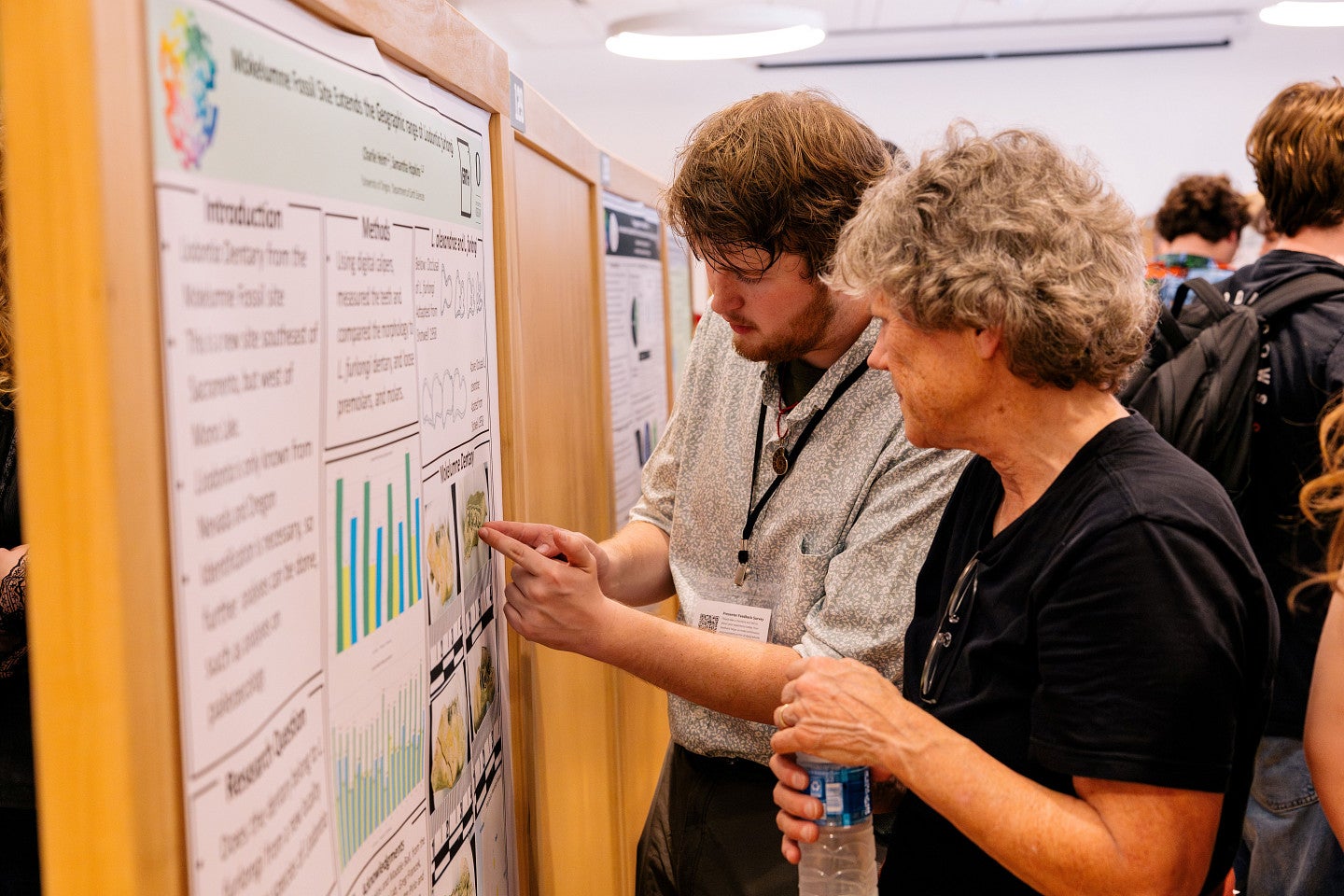
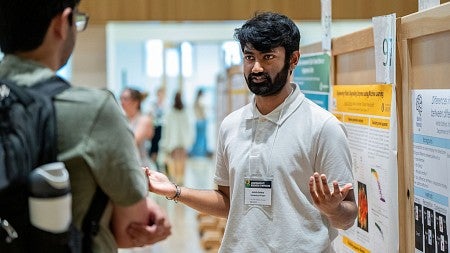
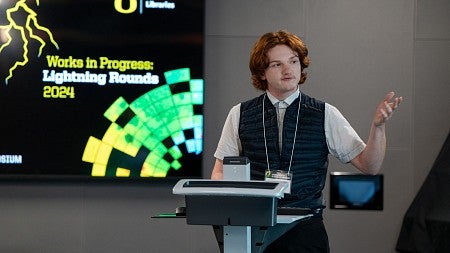
The University of Oregon Undergraduate Research Symposium provides an opportunity for undergraduates from all majors and academic disciplines to showcase their research, creative projects, works-in-progress while engaging deeply with the university's vibrant research culture of knowledge creation and dissemination. Students at every stage of their academic journey are welcome to participate - whether as presenters or attendees.
The symposium is a supportive and inclusive environment to explore ideas, share scholarly and creative work, and learn from peers and mentors. From first-year seminars and ARC inquiries to senior capstone projects, students are welcomed wherever they are in their academic journey. Every perspective is valued, and every contribution belongs.
Chaired by Kevin Hatfield, the symposium celebrates undergraduate discovery across the humanities, sciences, arts and social sciences. In collaboration with schools, colleges, departments, institutes, centers, and programs from across the institution, the event highlights both funded and independent work and fosters meaningful academic exchange.
This all-day event features flexible presentation formats, an Alumni Keynote Speaker, and a Welcome Reception- creating an experience that is both engaging and inspiring.
We invite you to join us to share ideas, learn from one another, and connect with the broader UO community. Your ideas matter. Your questions matter. Your research matters.
Interested in Participating?
The following guides and resources are available to those who would like to participate in the Undergraduate Research Symposium.
2026 Alumni Keynote Speaker
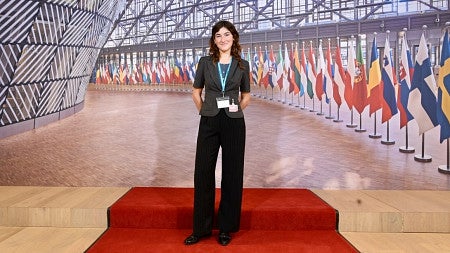
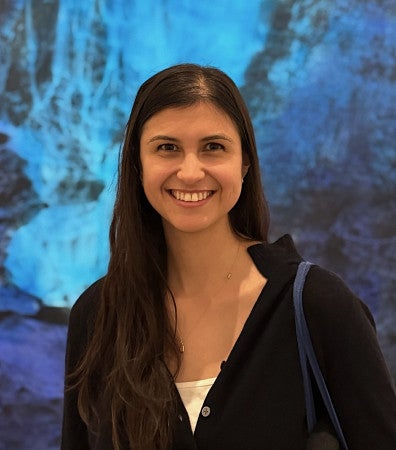
Mérida Mehaffey '18, Environmental Studies | History, is an interdisciplinary scholar based in Brooklyn, New York. She is currently a master’s student at Bard Graduate Center, where she studies museum ethics, curatorial practice, and Native American material culture. Her research is grounded in a strong belief in the importance of relational thinking, and its power to shape how knowledge is co-constructed.Mérida graduated from the University of Oregon in 2018, where she concentrated on environmental studies and cultural history. While pursuing her bachelor’s degree she participated in the University of Oregon’s Emerging Leaders Program and the McNair Scholars Program. As an undergraduate she traveled to New Zealand to study conservation and developed a deep interest in Oceanic art and cultural history. Through research on environmental history she began to explore the intersection of land-based knowledge, politics, and material culture.Mérida’s undergraduate honors thesis focused on the environmental history of Matiu Somes Island, which is situated off the coast of Wellington, New Zealand. This project also examined collaborative land management partnerships, between Maori and non-Maori stakeholders, that developed after treaty redress. As part of this process, Mérida conducted primary research in New Zealand, which was supported by a UROP mini grant. Her thesis experience opened up new questions about land politics and methodologies like oral history, both of which she has explored in her graduate work, through an art-historical lens.Soon after relocating to New York City to work in sustainable fashion, an experience teaching art history in New York City public schools led her to the museum field. In 2024 Mérida began pursuing a master’s degree in design history and material culture at Bard Graduate Center. Her graduate studies have taken her abroad to work at the Pitt-Rivers Museum and more recently at the Wheelwright Museum of the American Indian. Mérida is currently training as a curator and is part of the Metropolitan Museum of Art’s Alexis Gregory Curatorial Practice Program. Centering collaborative art-historical frameworks, she engages curatorial strategies that prioritize multivocality and epistemological diversity. Concentrated on ethical scholarship, Mérida also researches how to advance culturally-responsive, care-oriented methodologies in the museum field. Her central focus is contributing to public scholarship, which she does as a member of Bard Graduate Center’s Public Humanities and Research department.
Mérida was interviewed for the Oregon Humanities Center's UO Today podcast prior to her keynote address for the Undergraduate Research Symposium.
Timeline
January 5, 2026
Participation form opens
April 22, 2026
ASURE | UO Libraries DreamLab | 6:30 pmApril 28, 2026
JUMP | Price Science Library B006 | 3:00 PMSymposium Prep: Two Workshops
Join ASURE (Affiliated Students for Undergraduate Research Engagement) on April 22 for an interactive poster workshop designed to help you develop a visually compelling poster.Then April 28, connect with JUMP (Joint Undergraduate Mentorship Program) to sharpen your poster presentation and communication skills. While these sessions include poster-focused guidance, they are open to all modes of presenters looking to highlight their research work. RSVP to the JUMP workshop via this form.
Extended deadline: April 6, 2026
Participation form closes
May 7, 2026
Undergraduate Research Symposium event
General Agenda
Time | Event |
|---|---|
9:00 a.m. - 10:30 a.m. | Concurrent Oral Presentation Session 1 at the Erb Memorial Union |
9:00 a.m. - 10:30 a.m. | Works-in-Progress Session 1 at Price Science Commons VizLab |
10:45 a.m. - 11:45 a.m. | Works-in-Progress/Career Insights & Experiences Session 2 at Price Science Commons VizLab |
10:45 a.m. - 12:15 p.m. | Concurrent Oral Presentation Session 2 at Erb Memorial Union |
12:15 p.m. - 1:15 p.m. | Keynote Speaker at Erb Memorial Union Redwood Auditorium |
1:30 p.m. - 3:00 p.m. | Concurrent Oral Presentation Session 3 at Erb Memorial Union |
1:30 p.m. - 3:00 p.m. | Works-in-Progress/Career Insights & Experiences Session 3 at Price Science Commons VizLab |
3:15 p.m. - 4:45 p.m. | Concurrent Oral Presentation Session 4 at Erb Memorial Union |
4:30 p.m. - 6:30 p.m. | Poster Session at Erb Memorial Union Ballroom Area & Redwood Auditorium |
5:30 p.m. - 7:30 p.m. | Asian Studies Event at Erb Memorial Union |
All virtual presentation videos will be available on the Symposium YouTube channel as an ongoing digital exhibit of undergraduate research and creative work.
History
Since the debut in 2011, with 69 presenters and 40 faculty mentors spanning 20 majors and four colleges, the Undergraduate Research Symposium has only grown. It reached a pre-COVID-19 high-water mark in size and breadth its ninth year with 513 presenters and 290 faculty mentors spanning 75 majors, 21 minor programs, 33 minors, and eight colleges. Over the past 13 years the Symposium has hosted 5,249 student presenters and 3,084 mentors from 94 majors.
In response to the COVID-19 pandemic, the symposium transitioned to a virtual platform in 2020 and 2021, enabling 667 students to continue presenting their research and creative work with an expanded reach to peers, families, mentors, alumni, donors, and community members. The opportunity to record these presentations catalyzed the creation of a permanent digital exhibit of UO undergraduate research on the symposium YouTube Channel, curating 454 videos comprising over 1,100 research presentations.
In 2025, the 15th Anniversary of the symposium hosted 520 presenters and 384 research mentors. The record number of 492 presentations encompassed students from all eight colleges and schools, the Phil and Penny Knight Campus for Accelerating Scientific Impact, 86 majors and 77 minors. The breadth of participants is further illustrated by the 93 research centers, institutes, and laboratories that hosted undergraduate presenters. A record 344 presenters received funding to support their research and creative work from over 112 different internal and external sources.
Partnerships
The symposium has fostered a network of partnerships to incorporate high schools, community colleges, visiting undergraduates, alumni, donors, and community members into the annual program and as a gateway to the institution.
Through a collaboration with the Student Academy to Inspire Learning (SAIL) and Student Orientation Programs, thousands of high school students and teachers have enjoyed a campus visit day with a tailored presentation from the alumni keynote speaker and student panel as well as tours of labs, studios, theaters, and archives.
Lane Community College, Umpqua Community College, and Central Oregon Community College students and faculty have also attended and presented at the symposium with specialized transfer student panels and tours of Yasui Hall—home of the Transfer Scholars Residential Community.
Alumni advocates have continued to promote the Symposium to UOAA chapters nationally from the DC Ducks and PDX Ducks to the Lane County chapters.
We wish to extend our gratitude to the UO Libraries, the Knight Campus and the UO Institute of Neuroscience (ION) for funding the cost of printing research posters for presenters.
We also acknowledge the Oregon Humanities Center funding of the following presenter awards: Creative Writing-Kidd Program, English and Composition, Filmmaking, and Theater Arts.
Questions? Please email ugresearch@uoregon.edu. For information from peers about research and how to get involved, please email ASURE at asure@uoregon.edu.
Interested in Volunteering?
The role of the volunteer plays an integral role in building a supportive and successful environment for our student researchers, and we rely on the support of faculty, staff, graduate students, and alumni to ensure that the Symposium runs smoothly for our presenters and attendees. If you are interested in volunteering, you can review our open volunteer positions and available time slots using the volunteer sign-up button below. Please complete our brief sign up form no later than Wednesday, April 16th. We hope you will join us in putting together an exciting and safe event!